Why New Websites Fail to Rank on Google (And What Actually Fixes It)

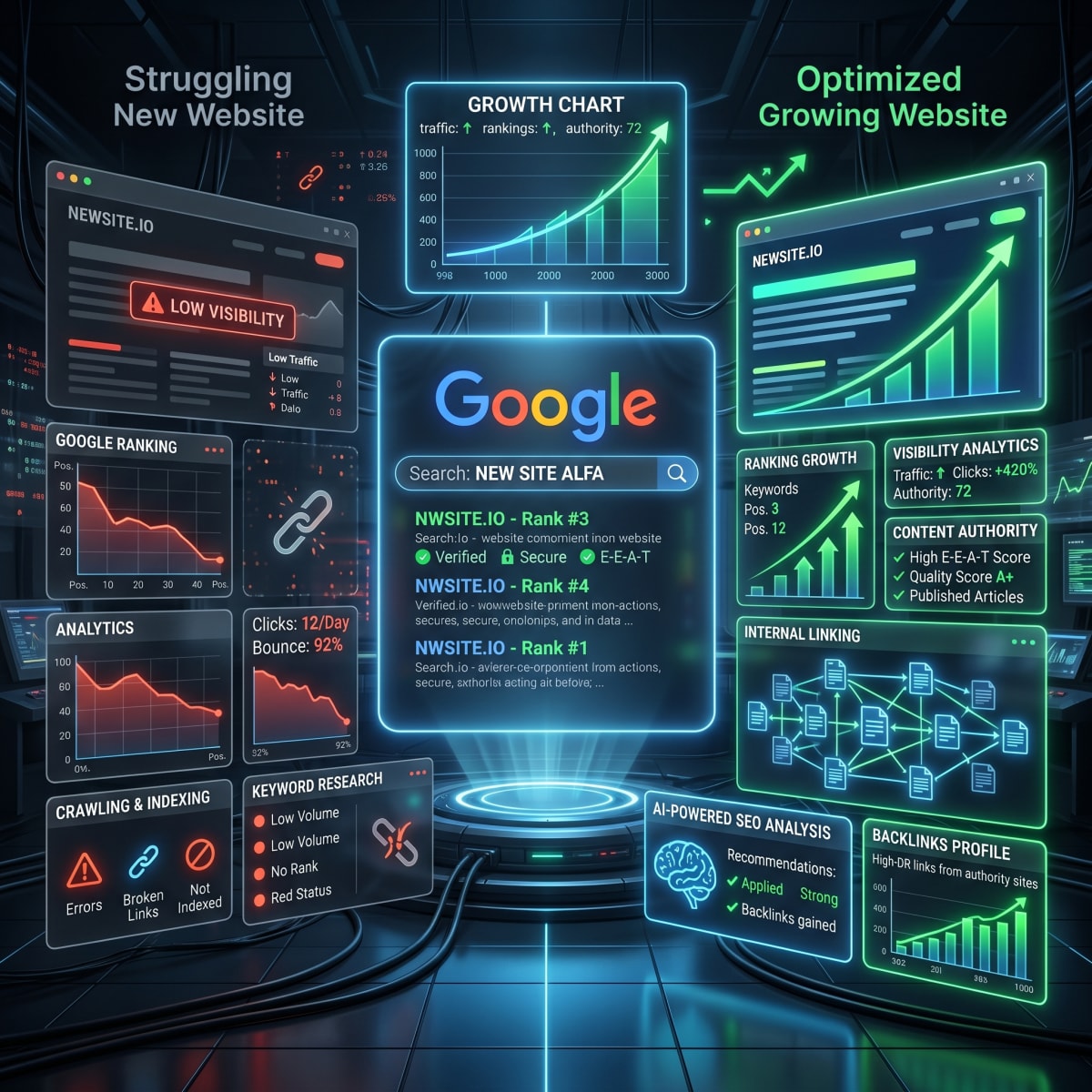
Why New Websites Fail to Rank on Google (And What Actually Fixes It)
Launching a new website is exciting, but many site owners quickly feel frustrated when their pages don’t appear on Google—even after weeks or months. The most common assumption is that something is technically broken, but in reality, ranking issues for new websites are usually caused by deeper SEO and trust-related factors.
This guide explains why new websites struggle to rank and what actually works to fix the problem in a sustainable, SEO-safe way.
1. Google Does Not Trust New Websites Immediately
Google treats new domains cautiously. Even if your pages load fast, are mobile-friendly, and are technically indexable, Google needs time to evaluate whether your website provides real value.
This trust-building phase is normal and affects almost every new domain.
2. Indexing Does Not Mean Ranking
Many site owners confuse indexing with ranking. Indexing only means Google knows your page exists. Ranking depends on relevance, content depth, and authority.
Before worrying about rankings, make sure your content is clean and readable. Even simple tools like a word counter help ensure your pages are not thin or underdeveloped.
3. Thin or Generic Content Is the #1 Reason New Sites Fail
If your content repeats what already exists online, Google has no incentive to rank it. New websites must provide clearer explanations, better structure, or more complete answers.
Long-form content that solves a real problem performs far better than short, surface-level posts.
4. Search Intent Mismatch
If users expect a guide and your page is promotional, Google will ignore it. Always analyze the top-ranking pages to understand what users actually want.
Formatting matters here. Tools like a JSON formatter or text cleanup tools help improve clarity and structure for both users and search engines.
5. No Topical Authority
Google prefers websites that cover a topic in depth rather than publishing random articles. One blog post is rarely enough.
For example, instead of writing only about SEO problems, create supporting content such as keyword guides, meta optimization tutorials, and sitemap explanations.
6. Weak Internal Linking
Internal links help Google understand your site structure and pass relevance between pages.
For example, when discussing performance or media optimization, linking to practical tools like an image optimizer strengthens topical relevance and user experience.
7. No External Trust Signals
New websites usually lack backlinks, brand mentions, or citations. While backlinks are not everything, having zero external signals slows trust.
Google explains how it evaluates and ranks pages in its official documentation at Google Search Central.
8. Over-Optimization Can Backfire
Keyword stuffing, forced headings, or unnatural anchor text can hurt new websites.
Focus on clarity and helpfulness instead of manipulating SEO signals.
9. Technical SEO Is Only the Foundation
Fast loading, mobile responsiveness, and clean URLs are essential—but they won’t rank your site alone.
Think of technical SEO as eligibility, not a ranking guarantee.
10. What Actually Works for New Websites
- Create fewer but deeper articles
- Target low-competition, long-tail queries
- Build topic clusters instead of isolated posts
- Use internal tools naturally within content
- Update and improve pages regularly
11. Realistic Ranking Timeline
Most new websites take 3–6 months to gain visibility and 6–12 months to stabilize rankings. This varies by niche and competition.
Final Thoughts
If your new website isn’t ranking yet, it doesn’t mean something is broken. It usually means Google needs more evidence of quality, relevance, and trust.
Focus on depth, consistency, and user value. Rankings follow naturally when you build for the long term.
Bắt đầu sử dụng Công cụ của chúng tôi ngay hôm nay
Trải nghiệm sự riêng tư và hiệu suất được đề cập trong bài viết này. Không cần tài khoản.
Khám phá tất cả hơn 150 công cụ